Smart glasses: when vision becomes intelligent
There was a time when glasses were only meant to correct vision or shield from the sun. Today, they observe, listen, translate, record, measure and interact with their wearer. Smart glasses have begun a quiet yet profound transformation, reshaping traditional optics and redefining our relationship with technology.
In a world where everything becomes “smart” — from watches to refrigerators — it was inevitable that eyewear would follow. And that shift is already well underway.

A revolution at eye level
What sets smart glasses apart from other connected devices is their proximity to our gaze. They’re not just worn — they integrate. They literally fuse with the field of view. Where a smartwatch wraps the wrist and a smartphone sits in the hand, smart glasses become a natural extension of human perception.
Their purpose is not to distract, but to enrich. They provide access to information without looking away from the real world. Turn-by-turn GPS guidance, a notification, an incoming call or an instant translation — everything unfolds along the line of sight, without breaking focus or pulling out a phone.
But reaching this level of symbiosis required nearly two decades of experimentation, innovation and persistence.
The rise of smart glasses: from science fiction to reality
Visionary prototypes and early setbacks
The story of smart glasses started long before mainstream adoption. In the early 2000s, MIT researchers were already experimenting with projecting information into the human field of view. In 2012, Google made headlines with Google Glass, the first smart glasses aimed at the general public.
The concept was revolutionary: a lightweight frame, a translucent display, a camera, a microphone and a direct connection to the internet. These glasses could record video, receive notifications and follow directions without ever touching a phone. Still, the project struggled commercially — limited battery life, a design too far ahead of its time, and immediate concerns around privacy.
Yet Google Glass opened a path. It proved technology could be woven into a frame without betraying its primary function. The idea was planted; society simply needed time to be ready.

It was also around this time that Apple CEO Tim Cook stated:
“I see augmented reality as a big idea, like the smartphone. The smartphone is for everyone… I think AR is as big.” — Tim Cook
A prescient view. Cook anticipated the role augmented reality would play in everyday life long before smart glasses matured.
The learning years: from Snap to Meta
In 2016, Snapchat launched Spectacles, glasses that could record and instantly share videos on the social network. The product amused, intrigued and sold by the thousands. Even if it didn’t reinvent the market, it marked a key step: smart glasses could be desirable.

Then came the design pivot. Major players realized technology alone wasn’t enough — you had to win the eye before augmenting the gaze. As Meta founder Mark Zuckerberg highlighted in 2021 when launching Ray-Ban Stories:
“We already wear glasses every day. It was time for this familiar object to become more useful and more intelligent — without losing its style.” — Mark Zuckerberg
This line captures the industry’s transformation. Smart glasses no longer hide behind technology; they embrace it elegantly.
When technology melts into the frame
Recent advances in miniaturization have changed everything. Batteries last longer, sensors vanish into the temples, open-ear speakers hide in the arms, and lenses can incorporate micro-OLED displays.
Today, a pair of smart glasses can house GPS, an accelerometer, a gyroscope, Bluetooth Low Energy, a directional speaker and a voice-assistant mic — all while keeping the lightness of a classic frame.
Voice and gesture controls are gradually replacing physical buttons. Say “Take a photo,” and the glasses comply. Listen to music, answer a call, or receive a message without ever lifting a hand to your phone.
This is no longer a gadget; it’s a true extension of sight — technology that fades away to better serve.
Ray-Ban Meta: when an icon meets intelligence
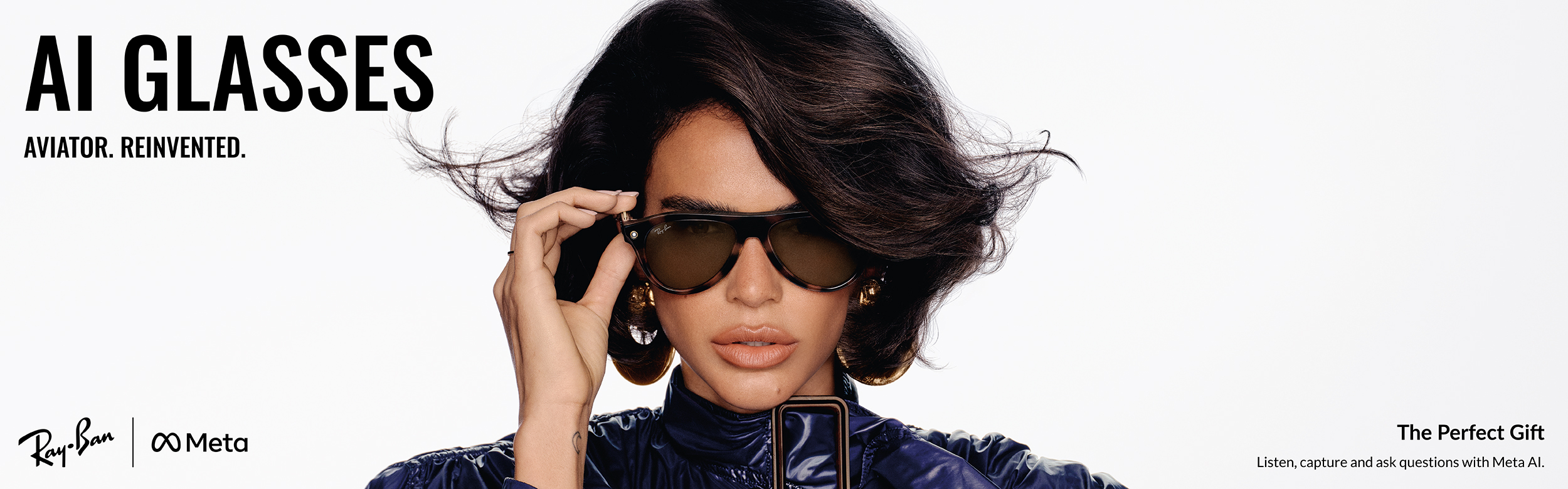
The collaboration between Ray-Ban and Meta perfectly embodies the fusion of tradition and innovation. With Ray-Ban Stories and now Ray-Ban Meta, the Italian brand proved it’s possible to keep timeless aesthetics while embedding digital power.
The frames revive iconic shapes like Wayfarer or Skyler, yet discreetly hide microphones, open-ear speakers, an HD camera and Bluetooth connectivity. Paired with the Meta View app, they let you snap a photo, record a moment, take a call or receive a notification — effortlessly.
This marriage of fashion and tech breaks with earlier attempts. The glasses don’t try to look like a device; they remain what they’ve always been: a style object. And yet, behind that elegant facade lies a complete digital world, constantly interacting with the smartphone.

At a Menlo Park conference, Mark Zuckerberg stated:
“Smart glasses won’t be an accessory. They’ll be the natural extension of our perception.” — Mark Zuckerberg
A vision that seems to come true day by day.
Sport through the lens: Oakley Meta redefines performance
If there’s one field where smart glasses quickly found legitimacy, it’s sport. Oakley, a pioneer in performance eyewear, combined its optical expertise with Meta’s technology to create Oakley Meta — glasses designed for motion, speed and precision.
Built for running, cycling and outdoor pursuits, they can surface essential data in real time: distance, heart rate, calories burned, respiratory rate and GPS cues. Thanks to compatibility with platforms like Garmin and Strava, metrics appear right when needed — without taking your eyes off the route.
The ergonomic fit hugs the face, PRIZM lenses boost contrast, and water resistance (IP67) makes them ready for all conditions. Oakley Meta Vanguard or HSTN represent a new generation of intelligent performance eyewear: glasses that analyze performance as well as they enhance it.

Ray-Ban Meta Display: an immersive future, already in sight
While today’s smart glasses mainly relay notifications, audio and quick captures, a new generation is poised to take a decisive step: integrated holographic displays.
Meta, Samsung and Huawei are working on glasses that can show a complete interface — messages, maps, calls, translations — directly in your field of view. Among the most promising, Ray-Ban Meta Display leads that revolution.
Featuring a waveguide lens and an embedded micro-projector, they overlay information onto the real world without compromising natural vision. As Meta explained at launch:
“Ray-Ban Display is designed to help you look up and stay present. With a quick glance you can check messages, preview photos, see translations or navigate — without reaching for your phone.” — Meta, 2025
These glasses embody the ultimate promise: a world where technology becomes invisible. The screen disappears; information remains — fluid, natural, almost organic.

Everyday uses: staying connected without switching off
Smart glasses are steadily entering daily life. Listen to a podcast while walking, receive a discreet alert, answer a call without earbuds, or get directions without glancing away.
They simplify life in a screen-saturated world — perhaps their greatest strength — reconnecting people with the real while softly layering the digital.
In professional settings, their utility goes even further. Surgeons use them to view vital data during procedures. Technicians consult schematics or hop on a video call without putting their tools down. Logistics teams track inventory by visual recognition.
In 2022, a surgeon in London even supervised live an operation in Dubai thanks to smart glasses and an augmented-reality video feed — a medical feat showing these technologies are already beyond the experimental stage.
Smart glasses are no longer mere gadgets; they are instruments for work, learning and assistance.
Challenges and responsibilities of innovation
Every major breakthrough raises questions. Smart glasses pose several: how far should image capture be allowed? How can data confidentiality be guaranteed? How can visual comfort be preserved in the face of omnipresent tech?
Privacy remains the central issue. Built-in cameras and microphones raise legitimate concerns. Aware of the risks, manufacturers now add record-indicator LEDs and strengthen data encryption.
“Smart glasses create a tension between seeing and being seen.” — Daniela K. Rosner, Maria Håkansson & Steve Howard, CHI Conference 2024
This line encapsulates the dilemma. Every glance can become a recording; every exchange, a data point. Wearing smart glasses also means carrying a responsibility: respecting the fragile boundary between observation and intrusion.
“Privacy is a fundamental human right. We must design technology with this principle at its core.” — Tim Cook, Apple CEO
A conviction that matters more than ever now that vision itself carries information.
The other challenge is battery life. Packing so much tech into such a slim chassis demands meticulous power management. For now, smart glasses typically last between six and ten hours of continuous use. Lithium-polymer cells and magnetic fast-charge systems already extend runtime, but research continues.
Finally, there’s social acceptance. Wearing technology on the face requires a shift in habits. The challenge for brands today is to make the tech disappear — so eyewear can reclaim its primary role: elevating the gaze.
“Technology should amplify human capabilities, not replace them.” — Satya Nadella, Microsoft CEO
The future: beyond the visible
Every era has its emblematic object. The 2000s crowned the smartphone; the 2010s, the smartwatch. The 2020s may well belong to smart glasses.
The convergence of optics, augmented reality and artificial intelligence signals a profound shift in how we see. These glasses won’t just inform; they’ll accompany us, understand our needs and anticipate our gestures.
Ray-Ban Meta Display and Oakley Meta are already pointing the way. And as immersive-tech expert Carlos López puts it:
“Smart glasses won’t just have a display; they’ll replace the way we interact with the digital world.” — Carlos López
That is the promise of this revolution: technology that steps back to make room for a new kind of perception — natural, intuitive and free.
Glasses are no longer just an accessory. They are becoming the gaze of the future.